When sellers move from Amazon, Taobao or other marketplaces to their own store, many copy the marketplace product name straight into the page's title tag. Marketplace titles are packed with specs, promos and synonyms so the internal search can match them. Google and AI search engines care more about whether a page clearly answers one search need. This guide walks through the comparison, the pitfalls, AI citations, a dual-track strategy and a step-by-step rewrite. Every statistic links to a public source, and nothing here promises rankings or AI citations.
Key takeaways (TL;DR)
- Drop marketplace-style keyword stuffing. Rewrite title tags as "core need + use case or benefit + brand".
- Google's own documentation lists repeated keywords in titles as something to avoid, because they can make results look spammy.
- AI summaries are taking some clicks away: independent research found people click result links less often when an AI summary appears. Track rankings and AI citations separately.
- Re-measure every change over the same time window: Search Console for search data, and a citation log for whether AI answers cite your page.
Marketplace titles vs. store title tags
The common shortcut is to take a marketplace title like "dress maxi summer floral slimming new" and paste it into Shopify. The problem is that the two systems read titles differently.
| Dimension | Marketplace product title | Store title tag on Google | | --- | --- | --- | | How it's matched | Internal search matches tokens to what buyers type | Search engines and AI read the whole page; the title is one signal | | Writing style | Fill every character, list synonyms, grammar optional | One readable sentence: what the page is and who it's for | | Length | Fixed platform limit | Google sets no length limit, but truncates the display to fit the device | | Repeated terms | Common practice | Google explicitly advises against it | | What's shown | Your title as written | Google may rewrite it, though it usually uses your title |
The last two rows are documented. Google's title link documentation says "there's no limit on how long a title element can be", but titles are truncated to fit the device width. The same page calls titles like "Foobar, foo bar, foobars, foo bars" keyword stuffing that can look spammy to Google and to users. In a 2021 update, Google said it uses the page's title element around 87% of the time.
❌ Common mistake: listing five or more synonyms, e.g. Running Shoes, Sneakers, Athletic Footwear, Jogging Shoes.
✅ Better approach: pick one core intent, write a readable sentence and put the brand last, e.g. "Men's Trail Running Shoes for Wet Terrain | Brand".
Why marketplace-style stuffing hurts on Google
The issue isn't the number of words; it's that a stuffed title doesn't answer a specific question. Google's spam policies list keyword stuffing as a violation, and the title documentation says boilerplate, repeated titles make pages hard to tell apart, which makes a rewrite by Google more likely.
AI summaries make this more important:
- Pew Research analysed real browsing data from 900 U.S. adults in March 2025. Users clicked a result link on about 15% of searches without an AI summary, versus about 8% when one appeared (Pew Research, July 2025).
- Ahrefs compared 300,000 informational keywords and found that an AI Overview correlated with a 34.5% lower average click-through rate for the top-ranking page (Ahrefs, April 2025).
In other words, a ranking brings fewer clicks than it used to. Your title has to make it obvious that the page answers the searcher's question to win the clicks that remain.
❌ Common mistake: assuming that putting every high-volume term in the title wins every long-tail ranking.
✅ Better approach: build the title around one intent, and spread related phrasing naturally through the body copy, H2/H3s and product specs.
How to write titles that ChatGPT and Perplexity can cite
A caveat first: no public study shows that rewriting titles lifts AI citations to a particular percentage, so treat such numbers with caution. Here's what is documented:
- AI search still relies on web indexes. Ahrefs' March 2026 update analysed 4 million AI Overview URLs and found 38% of cited pages also ranked in Google's top 10 for the same query (Ahrefs, March 2026). Ranking doesn't guarantee a citation, but being indexed and findable is still the starting point.
- Perplexity says PerplexityBot is used to surface and link websites in its results, and recommends allowing it in robots.txt if you want to appear (Perplexity docs).
- The GEO study by Princeton and others (KDD 2024) found that rewrites adding statistics, cited sources and quotations increased content visibility in generative engine answers in their experiments (arXiv:2311.09735). That's an experimental result, not a guarantee of the same lift on every site.
For titles, that means the title, H1, body and structured data should say the same thing. If the title says "Waterproof", the page should state the waterproof rating; if it says "for 3-Season Hiking", the page should explain the temperatures and weather it handles. When AI compares sources, consistent and verifiable pages are easier to use as an answer.
❌ Common mistake: titles that list only a model number, with no use case or problem solved.
✅ Better approach: include the use case people actually ask about, in natural language, e.g. "Ultra-Light Backpacking Tent for 3-Season Hiking".
What is the "SEO ranking + GEO citation" dual-track strategy?
Dual-track means measuring and working on two things at once: blue-link rankings in traditional search, and citations or mentions in AI answers.
| | Single track (rankings only) | Dual track (rankings + citations) | | --- | --- | --- | | What you measure | Keyword positions, impressions, clicks | Plus whether AI answers cite your page or mention your brand | | Data source | Search Console, rank trackers | Plus an AI citation log by question, engine and date | | Main risk | Rankings hold while traffic falls, and you can't see why | Treating a brand mention as a page citation; log them separately |
This explains a familiar pattern: core rankings stay flat while organic traffic drops. The Pew and Ahrefs data above show clicks fall when AI summaries appear. Looking only at ranking reports can make that look like a content or technical problem.
❌ Common mistake: spending the whole budget on traditional link building and ignoring how pages appear in AI answers.
✅ Better approach: keep core SEO going, fix a set of real customer questions, and check regularly whether AI answers cite your pages.
Step by step: moving beyond marketplace thinking
Step 1: Export and audit existing titles
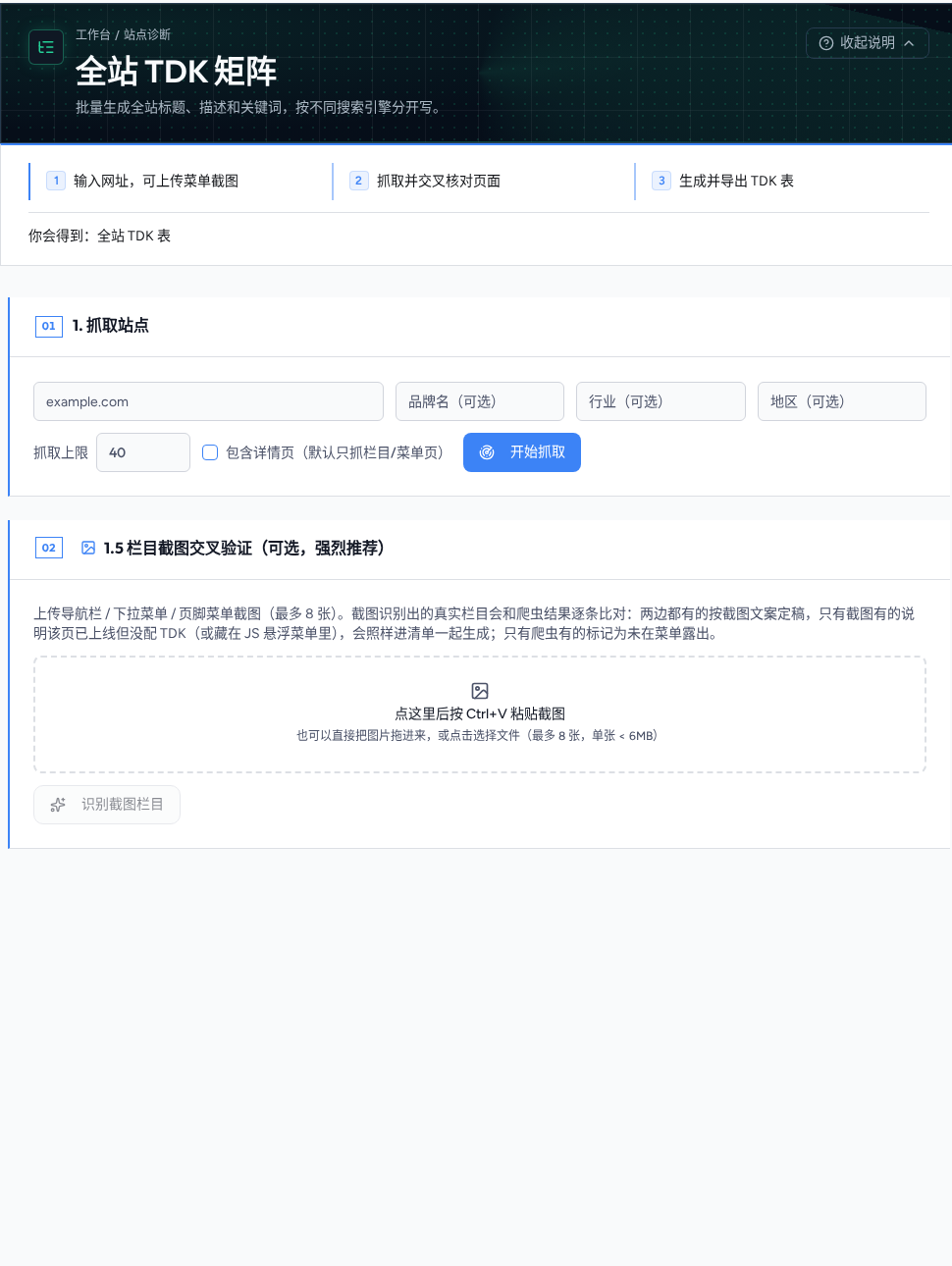
Pick priority pages from your catalogue, navigation and Search Console queries, then map titles and descriptions with the site TDK matrix. Look for three problems: the same words repeated, one template on every page, and titles that conflict with product specs. The screenshot shows the real 23SEOGEO input screen, not a client scan.
Step 2: Pick one core search intent
Sum up each page's value in one sentence. Don't ask "what do I want to sell?"; ask "how would a customer phrase this?" and "how would an AI describe this product?". Start with the page type:
| Page | Main intent | Example title (format only) | | --- | --- | --- | | Product | Check specs and use | Waterproof Hiking Backpack 30L · Weight & Fit Guide | | Category | Compare options | Hiking Backpacks for Weekend Trips · Size Guide | | Guide | Solve a problem | How to Choose a 30L Hiking Backpack for Rain |
These are writing examples, not tested keywords or search volumes.
Step 3: Rewrite with the formula and align the page
Rewrite as "core need + use case or benefit + brand". Every capacity, rating and use case in the title must be verifiable on the page; if the product is only water-resistant, don't call it waterproof. Remove unsupported "No. 1" or "officially recommended" claims. Structured data (Product, Offer) should match the visible price and stock. It helps machines read the page but doesn't guarantee rankings or citations.
Step 4: Re-test SEO and AI visibility separately
- In a verified property, export queries, impressions and clicks for the 28 days before the change. For new pages, note "no baseline yet".
- After publishing, check crawlability, canonicals and mobile display. Google may rewrite titles, so judge by what search results actually show, not the source code.
- Compare the same-length time window after the change.
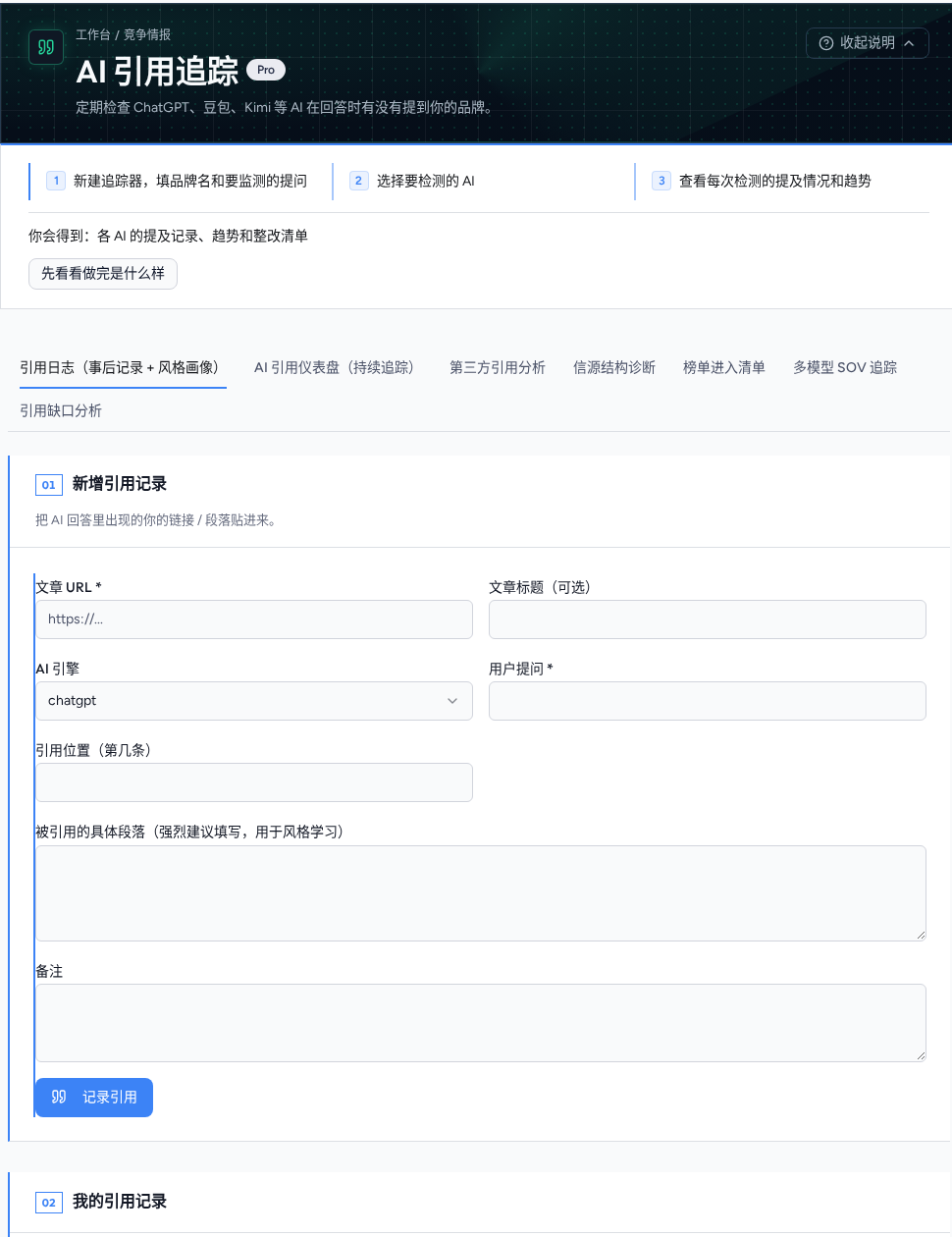
- Check AI visibility separately: log the question, engine, date and cited URL in AI citation tracking. A brand mention is not a page citation, and a tool score can't be turned into real traffic.
❌ Common mistake: rewriting titles on instinct and never checking the data afterwards.
✅ Better approach: change one batch at a time, record the date, and compare equal time windows so conclusions rest on evidence.
FAQ
How should I write title tags for my store?
Describe the page in one readable sentence: "core need + use case or benefit + brand". Don't stack synonyms, and keep the title consistent with the body and specs. Google sets no length limit, but long titles get truncated, so put the important words first.
Why doesn't marketplace-style keyword stuffing work on Google?
Marketplace search relies on keyword matching. Google's documentation explicitly lists repeated keywords in titles as something to avoid; such titles can look spammy and are more likely to be rewritten.
Do more keywords in the title mean better rankings?
No. An accurate description is easier for visitors to understand than repeated synonyms, and rankings also depend on content quality, accessibility and competition.
Will ChatGPT cite my page once the title is fixed?
Not necessarily. There's no public evidence that guarantees a citation. Log a page as "cited" only when you see a verifiable source link in a specific AI answer; otherwise log "not found".
Sources
- Google Search Central: Influencing title links in search results
- Google Search Central: More information on how Google generates titles (Sept 2021)
- Google Search Central: Spam policies
- Pew Research Center: Google users are less likely to click on links when an AI summary appears (22 July 2025)
- Ahrefs: AI Overviews Reduce Clicks by 34.5% (17 April 2025)
- Ahrefs: 38% of AI Overview Citations Pull From The Top 10 (2 March 2026)
- Perplexity: Perplexity Crawlers documentation
- Aggarwal et al.: GEO: Generative Engine Optimization (KDD 2024)
Related reading
For an industry-specific query map, see travel keyword research; for measurement options, read the webmaster tools guide.
About this article
Written by the 23SEOGEO team. All statistics come from the public sources listed above, with their publication dates. Example titles illustrate a method, and screenshots show product interfaces, not client results.