Cross-border sites used to see their traffic clearly through one SEO toolkit: indexing, rankings and backlinks. Now more users ask AI directly, so a site can be fully indexed with stable rankings and still see fewer enquiries. This guide compares eight common webmaster and SEO tools, what each can and can't see, and gives steps for managing rankings and AI citations together. Prices and features follow the official pages listed at the end (checked October 2026); scores and performance figures without public evidence are left out.
1. Why you need a new kind of webmaster toolkit
Traditional metrics can hide one shift: users get their answer from an AI summary and never click through.
- Pew Research analysed real browsing data from 900 U.S. adults. Users clicked a result link on about 15% of searches without an AI summary, and about 8% when one appeared (Pew Research, July 2025).
- Ahrefs compared 300,000 informational keywords and found an AI Overview correlated with a 34.5% lower average click-through rate for the top-ranking page (Ahrefs, April 2025).
That's how "core terms still rank top three, but traffic is down" happens. The problem may not be your content; users may simply be getting answers a different way. Ranking reports alone can't show you where they went.
A modern toolkit adds one question on top of indexing and rankings: when users ask AI, does the answer cite your pages?
2. Three criteria for choosing tools
- Is the data first-party? Only the search engines' own tools (Google Search Console, Bing Webmaster Tools) give first-hand indexing and click data.
- Can it see citations in AI answers? Can it log cited URLs by question, engine and date, and export raw records for checking?
- Does it support technical audits? Can it find crawl errors, redirects, duplicate titles and structured data issues?
Many sellers assume the most expensive SEO tool solves every traffic problem. In practice each tool has blind spots, and a combination usually beats one big subscription.
❌ Common mistake: expecting one traditional tool to cover all search traffic.
✅ Better approach: use official tools for indexing and clicks, third-party tools for competitors and technical audits, and an AI citation log for AI answers.
3. Eight webmaster tools compared
| Tool | Best for | What it shows | Starting price (official) | Main limitation | | --- | --- | --- | --- | --- | | Google Search Console | Google indexing and clicks | Your site's official impressions, clicks, index status | Free | Your site only, no competitor data | | Bing Webmaster Tools | Bing and Copilot | Indexing, IndexNow, AI Performance citation report (public preview) | Free | Doesn't reflect Google | | Perplexity crawler settings | Appearing in Perplexity | Control PerplexityBot access via robots.txt | Free | No webmaster dashboard or citation data | | Screaming Frog SEO Spider | Technical audits | Broken links, redirects, titles and meta, structured data | Free up to 500 URLs; $279/year licence | Desktop app; large crawls use local resources | | Semrush | Competitor and keyword research | Keyword database, traffic estimates, AI visibility toolkit | See pricing page | Traffic figures are third-party estimates | | Ahrefs | Backlinks and content research | Backlink index, keywords, Brand Radar AI visibility | See pricing page | Higher price; traffic is estimated | | Moz Pro | Basic SEO for small teams | Keywords, Domain Authority, AI visibility tracking | Standard $99/month ($79/month yearly) | Smaller data coverage than the leaders | | 23SEOGEO | Rankings and AI citations together | AI citations logged by question, engine and date; GEO Authority Score | See website | Records observations; can't be converted directly into traffic |
Prices come from each vendor's site (Screaming Frog pricing and licence pages, Moz Pro pricing). Semrush and Ahrefs change plans often, so check the Semrush pricing page and Ahrefs pricing page. We couldn't find a public "Perplexity Webmaster" product, so this guide covers Perplexity's official crawler documentation instead.
4. Tool by tool: who it suits, strengths and blind spots
Google Search Console
Google's free official tool. Suits every site. Strength: official impressions, clicks and index status from Google, the first-hand evidence for indexing problems. Blind spot: it only covers your site and doesn't separate clicks lost to AI summaries. Every cross-border site should install it.
Bing Webmaster Tools
Microsoft Bing's official tool. Strengths: real-time IndexNow submission, plus the AI Performance report in public preview since February 2026. It shows how often your content is cited in Microsoft Copilot and Bing AI summaries, which pages are cited and the related grounding queries (Bing Webmaster Blog, Feb 2026). It's one of the few sources of AI citation data from a search engine itself. Blind spot: nothing about Google.
Perplexity crawler settings
Perplexity has no public webmaster dashboard, but its documentation describes two user agents. PerplexityBot surfaces and links websites in Perplexity results, and Perplexity recommends allowing it if you want to appear. Perplexity-User fetches pages live when users ask questions (Perplexity docs). Recommendation: check robots.txt and firewall rules so you don't block these crawlers by accident.
Screaming Frog SEO Spider
A desktop crawler. Suits technical SEOs and developers. Strengths: finds broken links, redirects, duplicate titles, hreflang and structured data issues. The free version crawls 500 URLs; a licence costs $279 a year. Blind spot: a technical interface, and large crawls consume local resources.
Semrush
An all-round digital marketing platform. Suits teams with budget for competitor analysis. Strengths: a large keyword database, detailed competitor analysis and now an AI visibility toolkit. Blind spot: traffic numbers are third-party estimates and can't replace Search Console data.
Ahrefs
An SEO platform known for backlink analysis. Suits teams doing link and content research. Strengths: a large backlink index, plus Brand Radar for tracking brands in AI answers. Blind spot: higher price, and traffic is estimated.
Moz Pro
An SEO platform for small and mid-sized teams. Suits teams starting out on a budget. Strengths: an intuitive interface and the widely used Domain Authority metric. The Standard plan is $99/month and includes AI visibility tracking with 50 tracked prompts. Blind spot: smaller data coverage than the leaders.
23SEOGEO
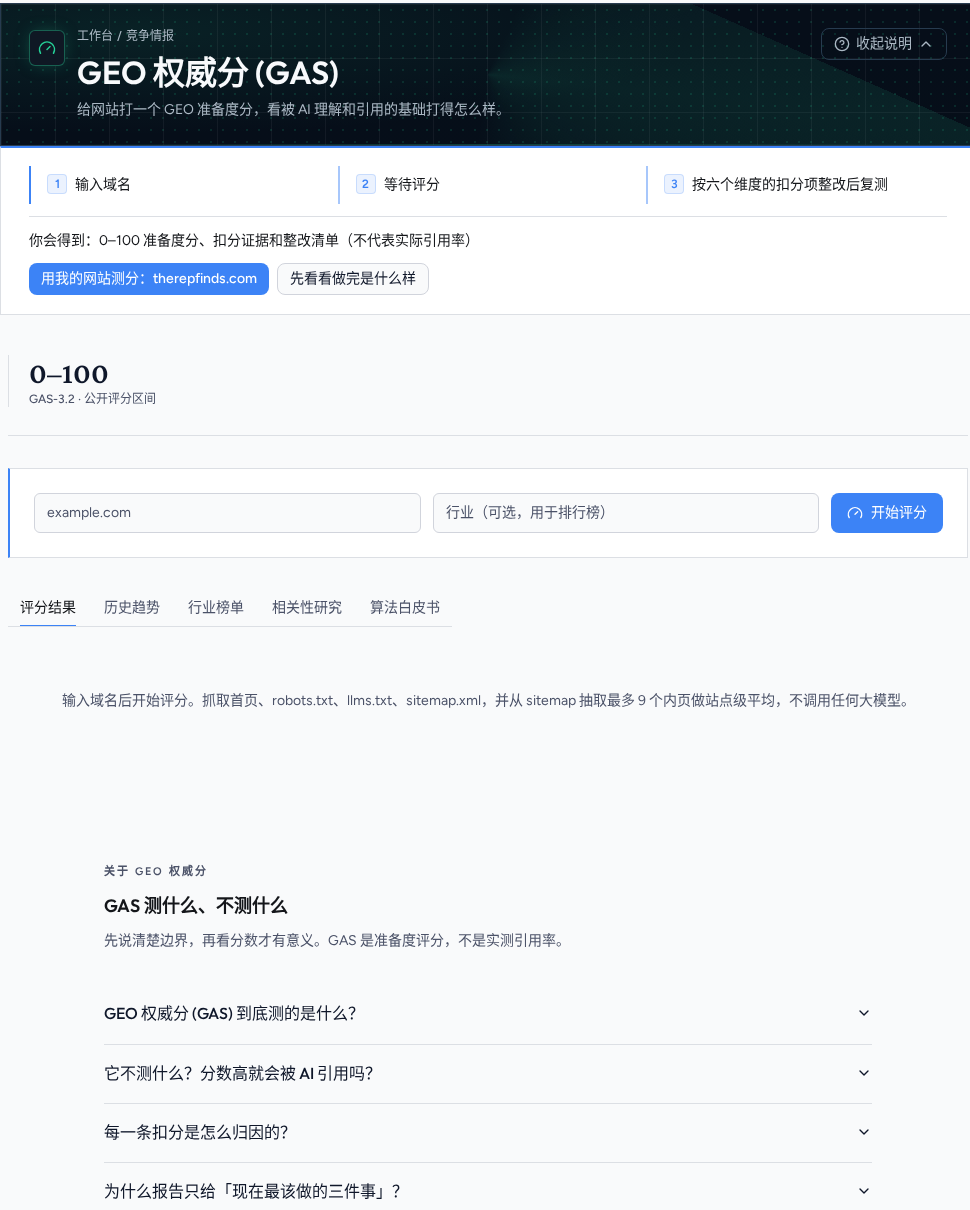
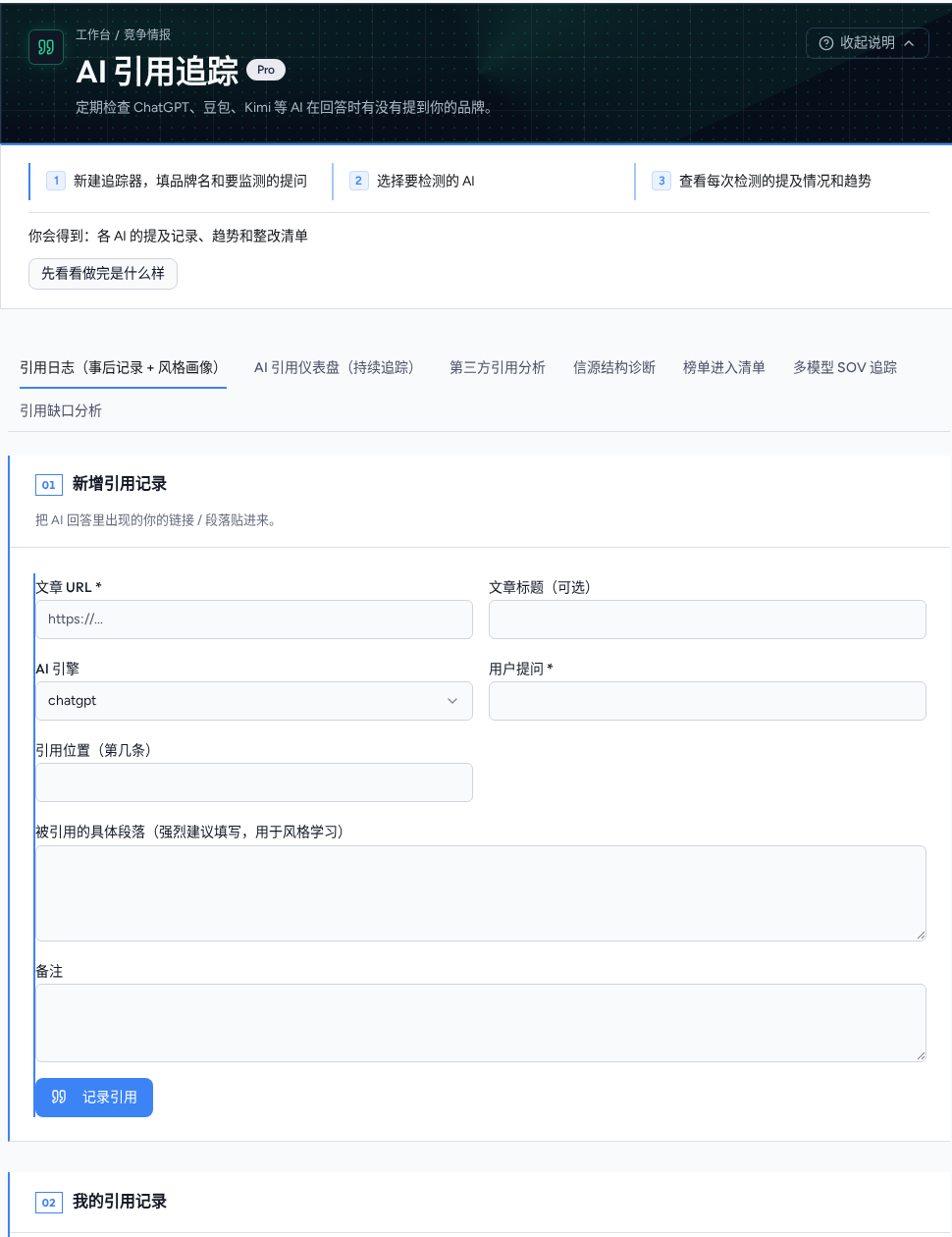
A tool focused on AI visibility. Suits stores and SaaS teams that want rankings and AI citations in one view. What it does: logs cited URLs in AI answers by question, engine and date (AI citation tracking), and uses the GEO Authority Score to check whether a site has the basics in place to be cited. Limits: it records observations, which can't be converted directly into orders or traffic, and the GEO Authority Score measures readiness, not actual citation rate.
5. Running a "rankings + AI citations" dual-track strategy
A common question: what's the real difference between traditional webmaster tools and GEO tools?
Traditional tools tell you what people searched, where you rank and how many clicks you got. GEO tools tell you whether an AI answer to a complex question used your page as a source. One looks at rankings and clicks; the other looks at citations and sources.
They're connected because AI search still relies on web indexes. Ahrefs' March 2026 study found that 38% of pages cited in AI Overviews also ranked in Google's top 10 for the same query (Ahrefs, March 2026). So you can't drop core SEO, but core SEO alone isn't enough: many cited pages sit outside the top 10.
❌ Common mistake: assuming good basic SEO means AI engines will automatically find and recommend you.
✅ Better approach: check who AI answers actually cite, adjust your page structure accordingly, then re-test.
6. How to use webmaster tools to improve your chances of AI citations
- Check where you stand: pick 5–10 business questions real customers ask, ask them in several AI engines, and record whether answers mention your brand or cite your pages. Where they don't, note who is cited.
- Analyse what gets cited: is it a definition, a data point or a comparison table? AI answers tend to favour clearly structured, factual, no-fluff passages.
- Rewrite key pages: open important pages with a short paragraph that answers the question directly, and add comparison tables, concrete steps and sourced data.
- Check crawler access: make sure robots.txt and firewalls don't block Googlebot, Bingbot, PerplexityBot and similar crawlers.
- Build a re-test loop: after changes, re-ask the same questions and compare Search Console, Bing AI Performance and your AI citation log.
A budget stack: Google Search Console and Bing Webmaster Tools (both free) for indexing and official data, the free version of Screaming Frog for technical audits, plus a tool that logs AI citations. That covers most needs; add Semrush or Ahrefs when you need competitor research.
FAQ
What's the difference between traditional webmaster tools and GEO tools?
Traditional tools track rankings, clicks and indexing; GEO tools track whether AI answers cite your pages. They complement each other and can't replace one another.
Is there an official source of AI citation data?
Yes. Bing Webmaster Tools' AI Performance report (public preview since February 2026) provides citation data from Copilot and Bing AI summaries. Google doesn't currently report AI citations separately in Search Console.
Which tools should I start with on a tight budget?
Install Google Search Console and Bing Webmaster Tools first (both free), then use the free version of Screaming Frog for technical checks. Consider paid tools when you need competitor data.
Sources
- Pew Research Center: Google users are less likely to click on links when an AI summary appears (22 July 2025)
- Ahrefs: AI Overviews Reduce Clicks by 34.5% (17 April 2025)
- Ahrefs: 38% of AI Overview Citations Pull From The Top 10 (2 March 2026)
- Bing Webmaster Blog: Introducing AI Performance in Bing Webmaster Tools (10 Feb 2026)
- Perplexity: Perplexity Crawlers documentation
- Official pricing: Screaming Frog, Moz Pro, Semrush, Ahrefs
Related reading
For hands-on examples, follow the independent-store title workflow and the travel keyword map.
About this article
Written by the 23SEOGEO team. Tool prices and features follow the official pages above (checked October 2026) and may change at any time. Screenshots show real product entry points, not client results.