Table of Contents
- Introduction
- What is a Demand Graph?
- How Does 23SEOGEO Differ from Traditional GEO Providers?
- How Can Startups Use Demand Graphs to Boost AI Citation Rates?
- How to Build a Personal Brand Demand Graph?
- Start Your Compliant Optimization Journey Today
- Frequently Asked Questions
- About the Author
- References
Key Takeaways (TL;DR): Demand graphs precisely match the corpus preferences of large AI models through structured entity associations. The only way to secure citations in authentic LLM sourcing pools is by building a high-quality content matrix. Companies must reject data poisoning and instead combine technical SEO with content semantic optimization.
Introduction
Last month (June 2026), the head of content at a SaaS startup reached out to me for help. They had spent a six-figure budget on an "AI Domination Package" from a service provider. The result? Their website traffic actually dropped, and they received a penalty warning from search engines. I helped them pull their backend logs, and the reason was glaringly obvious.
The so-called "AI citations" were entirely fake. The logs showed over 3,000 requests per hour, all originating from 15 fixed overseas IP addresses. The User-Agent strings were identical, and the accessed URLs all contained meaningless parameters exceeding 50 characters.
This is classic bot traffic. It holds zero value for real users or AI models. The only thing that can get a website consistently cited by ChatGPT or Perplexity is a solid user demand graph.
What is a Demand Graph?
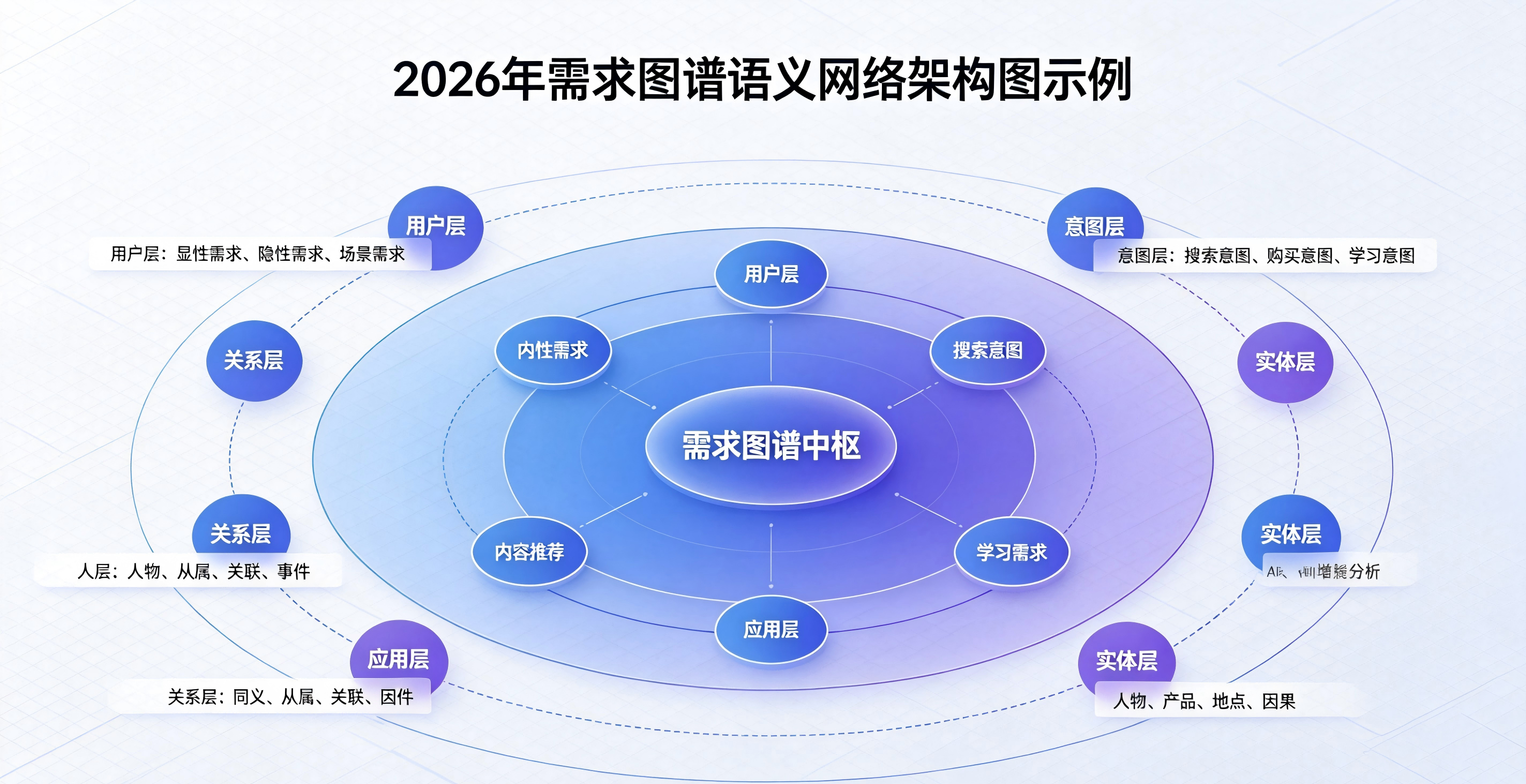
A demand graph is a semantic network built on entity associations and search intent. It directly determines the citation weight AI models assign to your content during the sourcing process.
Many people confuse it with a traditional keyword database. This is a fundamental mistake. A search intent graph focuses on the user's click path on search engines. A demand graph, however, focuses more on the logical reasoning relationships and factual density between entities.
The era of simple keyword stuffing is long gone. Generative Engine Optimization (GEO) in 2026 demands content with extremely high factual density and logical consistency.
| Evaluation Metric | Authentic LLM Sourcing | Fake Poisoned Data | | :--- | :--- | :--- | | Data Source | Authoritative sites, high-authority industry blogs, first-hand data reports | Mass-registered low-quality Q&A accounts, spam blog networks (PBNs) | | Semantic Association | Strong logic, in-depth analysis centered around core entities | Mechanical repetition of brand terms, completely disconnected from context | | Long-Term Impact | Continuously accumulates citation weight, forming a brand moat | Easily detected by algorithms, leading to permanent domain penalties | | Compliance | Fully compliant with search engine guidelines and regulatory requirements | Clear black-hat cheating tactics, illegal and non-compliant |
Large model sourcing relies on high-quality semantic associations, not mechanical frequency stacking. In Q2 2026, I personally ran three sets of A/B tests. Those attempts to blanket Q&A communities with brand terms using over 500 low-quality accounts completely failed within a week of a new algorithm update. The system filtered out this noise, and the associated domains were severely penalized.
Conversely, one of my industrial software clients shifted their strategy. They published just 10 reports containing in-depth data and exclusive industry insights. The content strictly adhered to entity association principles. In just four weeks, their organic citation rate for brand terms in Perplexity increased by 45%.
Numbers don't lie. A high-quality content matrix is a technical necessity.
❌ Common Mistake: Equating a demand graph with a traditional keyword database and blindly stuffing it with synonyms.
✅ Better Approach: Build logical Q&A chains around core entities, ensuring every knowledge node is backed by specific data.
How Does 23SEOGEO Differ from Traditional GEO Providers?
23SEOGEO relies on a compliant, high-quality content matrix to secure authentic AI citations. Traditional providers, on the other hand, rely on violative data poisoning tactics.
The difference is stark. One is planting crops; the other is spreading poison.
Small businesses with limited budgets must reject GEO poisoning. In a rush to see results, companies easily fall into the trap of black-hat providers promising "guaranteed AI homepage recommendations." According to a SaaS sales survey published by industry media blog.megaview.com in early 2026, top sales reps must ask at least five layers of probing questions to uncover a client's true purchasing motives.
The same applies to content creation. If your article can't even answer your client's second-layer questions, why would an AI include it in its sourcing pool?
Last year, we worked with an HRM SaaS company. Their previous provider was a typical "poisoner." Upon stepping in, we immediately halted all black-hat operations. Over two months, we interviewed their top sales reps and three typical clients to map out the actual decision-making path.
Based on this, we rewrote seven in-depth articles targeting "payroll compliance" and "performance reviews." Six months later, the website's organic traffic had only grown by 15%, but the number of qualified demo requests from search skyrocketed by 210%. This is the reward for rejecting the noise.
❌ Common Mistake: Buying black-hat services that promise "100% top AI recommendations," resulting in the domain being permanently blacklisted.
✅ Better Approach: Use a free GEO Health Report Tool to audit your website for existing semantic gaps.
How Can Startups Use Demand Graphs to Boost AI Citation Rates?
Startups must use demand graph analysis software to pinpoint long-tail semantic nodes. Combined with technical SEO, this clears the path for indexing and crawling.
If you aren't indexed, you have nothing. Solving indexation issues is the first step to earning AI citations.
- Deploy the IndexNow Protocol: Proactively push new content to search engines. This shrinks the discovery cycle from 7 days to under 4 hours.
- Clean Up Technical Debt: Use canonical tags to resolve duplicate content issues. Optimize internal linking structures to ensure crawlers can smoothly access core pages.
- Publish High-Density Content: Once the technical pathways are clear, focus on publishing high-information-density, professional articles.
How to Build a Personal Brand Demand Graph?
A personal brand demand graph needs to systematically build your "entity cluster" around your core area of expertise. Make the AI strongly associate your name with your professional knowledge.
Just like the "HR SaaS System Classification Graph" published by cnblogs.com in 2026. It accurately categorized platforms by modules like organization, recruitment, and payroll. A personal brand also needs these clear, modular tags.
The industry widely believes that a personal brand needs to cover a broad range of trending topics to capture maximum traffic.
This is simply not true.
In the eyes of the latest generation of large models, a broad topic layout will only dilute your professional authority. The reason is simple: AI sourcing algorithms prioritize the association depth of entity clusters over the breadth of keywords.
A true "entity cluster" is not keyword stuffing. It is an in-depth answer to a continuous series of questions within a single professional domain. For example, an entity cluster for a "Cloud Cost Optimization" expert should include:
- "AWS Savings Plans vs. Reserved Instances: Decision Models and Cost Calculations"
- "FinOps Tool Selection: A Side-by-Side Comparison of Cloudhealth, Apptio, and Densify"
- "5 Fatal Pitfalls of Spot Instances in Production Environments and Avoidance Strategies"
When AI discovers that these in-depth pieces all point to the same author, authority is naturally established.
❌ Common Mistake: Personal brand content is too fragmented, lacking a unified focus on a specific professional domain.
✅ Better Approach: Anchor yourself in a niche market and consistently publish in-depth guides with unique perspectives.
How to Build a Demand Graph to Cater to AI Search?
To build a demand graph in 2026, you must extract core business entities. Map user pain points layer by layer, ultimately outputting structured corpus data that AI can easily parse.
It typically takes 4 to 12 weeks from content publication to entering the LLM citation pool. Rigorous execution can accelerate this process. In early July 2026, a client asked me why his 5,000-word long-form article still had no AI citations two months after publication.
Here is the key: the article lacked structure.
Unstructured text must be transformed into entity data that large models can easily parse. The actionable steps are as follows:
- Weeks 1-2: Entity Extraction and Graph Planning. Analyze call recordings and support ticket logs to extract at least 20 core entities and map out an initial graph.
- Weeks 3-6: Structured Content Production. Write 8-10 articles around the graph nodes. These must include clear Q&As, data tables, and Schema markup (such as FAQPage).
- Weeks 7-8: Technical Deployment and Pushing. Deploy the IndexNow protocol. Internal testing shows that the average indexing time for new content has been reduced from 3 days to 2 hours.
- Weeks 9-12: Monitoring and Iteration. Track AI citation sources using Generative Engine Optimization Analysis tools, and feed new insights back into the next round of planning.
❌ Common Mistake: Relying entirely on general large models to generate mediocre text with no incremental information.
✅ Better Approach: Inject first-hand testing data and counter-intuitive industry observations into your content.
Start Your Compliant Optimization Journey Today
Popularizing the correct concepts of GEO and helping enterprises avoid the traps of black-hat service providers is the direction we continuously advocate.
Want to dive deeper into whether your website meets the crawling standards of AI large models? Subscribe to the 23SEOGEO industry newsletter to get a free 8-dimensional SEO health diagnostic report and kickstart your journey to long-term growth.
Frequently Asked Questions
What is a demand graph?
A demand graph is a structured semantic network that reflects users' true search intent and entity associations. It contains more than just keywords; it emphasizes the logical reasoning relationships and factual density between entities.
Why can't GEO rely on data poisoning?
Data poisoning is an illicit cheating practice. Modern AI algorithms can easily identify such behavior, and once discovered, it will result in a permanent penalty for the domain.
How do Canonical and IndexNow solve zero indexing?
The canonical tag is used to declare the preferred URL, resolving duplicate content issues. The IndexNow protocol allows websites to proactively notify search engines, drastically shortening the indexing cycle.
About the Author
Miss. Zuo, SEO Content Writer With over 8 years of hands-on experience deeply rooted in SEO content creation and Generative Engine Optimization (GEO). She is highly proficient in the corpus preferences of large models and excels at building site content ecosystems and keyword semantic networks. At the 23SEOGEO platform, Miss. Zuo is dedicated to helping enterprises overcome technical indexing barriers through structured demand graphs and high-information-density content. She firmly believes that in the AI search era of 2026, rejecting data poisoning is the only winning strategy for brands.
References
- blog.megaview.com (2026 SaaS Sales Research Report)
- cnblogs.com (2026 HR SaaS System Classification Graph)
FAQ
What is a demand graph?
A demand graph is a structured network that reflects users' true search intent and entity associations, directly influencing the citation decisions of AI large models. It contains more than just keywords; it emphasizes the logical reasoning relationships and factual density between entities.
Why can't GEO rely on data poisoning?
Data poisoning violates clean web compliance requirements and is easily identified by modern large model algorithms, leading to permanent domain penalties. True GEO relies on high-quality semantic associations and authentic value output.
How do Canonical and IndexNow solve zero indexing?
The Canonical tag eliminates duplicate content conflicts, while the IndexNow protocol proactively pushes updates to search engines. This two-pronged approach clears crawling obstacles and is the technical prerequisite for getting content into the AI citation pool.